
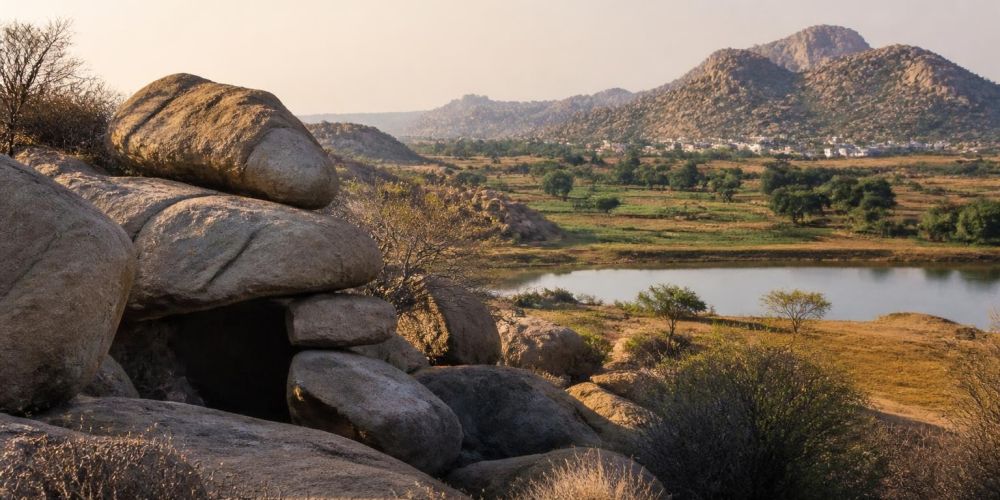
Jawai is often introduced through its leopards and dramatic granite hills. Yet its wildlife landscape is larger and more connected than a single safari viewpoint or a line drawn around a protected area. In Pali district, rocky slopes, natural caves, water bodies, grazing land, farms and village settlements sit close together.
This guide explains the notified Jawai conservation reserves, why leopard habitat can extend beyond their boundaries, how the surrounding countryside contributes to the ecosystem, and what responsible visitors should know. It also summarises the High Court’s 5 September 2026 judgment; this is not legal advice.
Jawai is a landscape, not one fenced safari park
Jawai is a lived-in rural landscape. Its ecological features overlap with places where people farm, graze livestock, travel and live. In its September 2026 judgment, the Rajasthan High Court described the region as a mixed-use ecological area containing forest land, notified conservation reserves, revenue land, private holdings, community grazing land, granite hills, caves, water bodies and village settlements.
This explains why leopard habitat may be found near a working field, village route or rocky slope rather than deep inside a large forest block. The court also recorded that leopard habitat and movement extend into surrounding revenue, community and privately held lands beyond the notified reserve boundaries.
What are the notified Jawai conservation reserves?
The Rajasthan Forest Department’s protected-area list records two Jawai entries under its conservation-reserve category: Jawaibandh Conservation Reserve in Pali, listed at 19.79 square kilometres, and Jawai Bandh Leopard Conservation Reserve-II in Pali, listed at 61.98 square kilometres. These are separate entries in the official list; they should not be casually added together and described as one continuous, uniformly accessible reserve.
The distinction between a notified reserve and the wider leopard landscape matters. A notification establishes a defined legal area, but it does not mean every leopard, cave or movement route in the region lies inside that boundary. The court referred to reserve notifications dated 27 February 2013 and 15 June 2018, while noting that the wider habitat extends into surrounding land categories.
Why do granite hills and caves matter?
Jawai’s granite outcrops are among its most recognisable features. Weathered rock faces, boulder fields, slopes and natural openings create varied terrain. The High Court identifies caves and rocky formations as resting, denning and breeding sites for leopards, and recognises the importance of connected foothills and movement corridors.
A cave is not simply a photogenic opening in a rock. Depending on its use, it may provide shelter, a resting place or a sensitive breeding location. Not every cave or leopard sighting has the same ecological status. The court specifically cautioned that a transient sighting should not be equated with an active den, breeding site, high-use resting area or established movement corridor.
Do not climb into caves, approach openings or block narrow paths for photographs. Follow guide instructions and current area restrictions.
How do villages, grazing land and wildlife share the region?
Jawai’s countryside includes settlements and customary livelihood areas alongside wildlife habitat. Livestock grazing, agriculture, water collection and village travel are part of everyday life. These activities help explain how people use the same broad area in which leopards and other wildlife move.
A Wildlife Institute of India study conducted in the Jawai Dam landscape between December 2016 and April 2017 examined leopard ecology and villagers’ perceptions. Its findings underline that human–leopard relationships are complex. The study recorded local tolerance and cultural or religious attitudes, while also noting that livestock losses could create economic costs for residents. It cautioned against treating the mere presence of people and leopards as proof that every challenge of coexistence has been solved.
Tourism may create income and interest in conservation, but its benefits do not automatically reach every household or offset every cost borne by residents. Treat villages as living communities, not scenery, and never assume people want to be photographed.
When passing through rural areas, keep vehicles on permitted roads, give livestock and herders space, avoid blocking access, and ask permission before photographing people, homes or private activities. Do not enter fields, grazing areas or private land because a location looks attractive.
What changed with the Rajasthan High Court’s September 2026 judgment?
In Apoorva Agrawat v. State of Rajasthan, D.B. Civil Writ Petition No. 5128/2026, decided on 5 September 2026, the Rajasthan High Court set out directions for protecting leopard habitat across the Jawai landscape. The judgment recognises that ecological features and wildlife movement may extend across forest, revenue, private and community land.
The court adopted an interim one-kilometre Leopard Habitat Construction-Control Zone around identified or mapped critical habitat features such as caves, dens, breeding sites, high-use resting sites, connected foothills and movement corridors. It describes this as an interim, evidence-informed regulatory threshold pending scientific mapping and a comprehensive State policy. It is not a permanent ecological boundary and should not be interpreted as a universal one-kilometre rule measured from every casual leopard sighting.
The judgment also distinguishes ordinary village and livelihood needs from activities that may damage habitat. It sets out treatment for bona fide residential work in existing village settlement areas, repairs to lawful homes, essential public utilities and traditional agriculture or grazing that does not fragment or obstruct wildlife movement, subject to applicable permissions and wildlife-friendly conditions. Restrictions on night safaris, baiting, artificial lighting, drones, mining in specified areas and fencing that obstructs wildlife movement also continue.
Visitors should follow current instructions from authorised operators and local authorities. Older brochures and social-media posts may not reflect the latest directions.
Why habitat mapping is important
The court directed the Deputy Conservator of Forests, Pali, working with the Revenue Department and the relevant coordination committee, to prepare a provisional geo-referenced map. It is to identify known caves and dens, breeding and resting sites, cave-bearing hills, foothills, wildlife corridors, wetlands, water sources, settlements, roads and tourism clusters. The direction provides for public disclosure through official channels and display at concerned Gram Panchayats.
Such a map can help authorities consider the landscape as a connected system rather than treating each cave, road or construction proposal in isolation. It is an administrative and conservation tool, not a tourist attraction map. Do not rely on unofficial pins that claim to reveal leopard caves or exact resting places. Sharing sensitive wildlife locations can increase disturbance.
Visitors should follow currently permitted routes. For formal mapped information, consult the Forest Department or District Collector, Pali, rather than relying on copied images or old location lists.
How to experience Jawai responsibly
Choose a local operator who explains the rules clearly and prioritises wildlife welfare over close-up photographs. Stay in the vehicle or viewing area as instructed, keep noise low, never feed or bait an animal, and do not ask a driver to block a cave entrance or surround a leopard. A sighting is a privilege, not a performance that can be demanded.
Outside a safari, avoid litter, loud music and off-road driving. Do not fly drones or use artificial lights to locate wildlife. Keep away from restricted water edges and operational infrastructure around Jawai Bandh. Respect village roads, working farms and grazing routes, and ask before taking photographs of residents.
These choices reduce disturbance and respect the communities who live here throughout the year.
Frequently asked questions
Is Jawai one large national park?
No. Jawai is a wider rural and ecological landscape that includes notified conservation reserves as well as revenue land, private holdings, community grazing areas, villages, water bodies and other habitat features.
How many Jawai conservation reserves are listed by the Rajasthan Forest Department?
The Department’s protected-area list includes two Jawai entries under conservation reserves: Jawaibandh Conservation Reserve and Jawai Bandh Leopard Conservation Reserve-II. They are listed separately.
Do leopards stay only inside the notified reserve boundaries?
No. The Rajasthan High Court’s September 2026 judgment records that leopard habitat and movement extend into surrounding revenue, community and privately held lands beyond the notified boundaries.
Can visitors approach leopard caves?
No. Do not approach, enter or disturb caves. Use permitted viewing arrangements and follow authorised guides and local authorities.
Does the one-kilometre zone apply to every leopard sighting?
No. The judgment describes an interim construction-control framework around identified or mapped critical habitat features. It distinguishes a transient sighting from an active den, breeding site, high-use resting area or established movement corridor.
Where can I check official information before visiting?
Check current information with the Rajasthan Forest Department, District Collector, Pali, and your authorised local operator. For general destination background, read the About Explore Jawai page.
See Jawai as a connected living landscape
The character of Jawai comes from the relationship between its granite hills, caves, water, wildlife and working villages. The notified conservation reserves are important, but they are only part of a wider ecological picture. Understanding that connection makes a visit more meaningful: take time to notice the terrain, respect the people who live here and recognise why habitat protection must consider the whole landscape.