
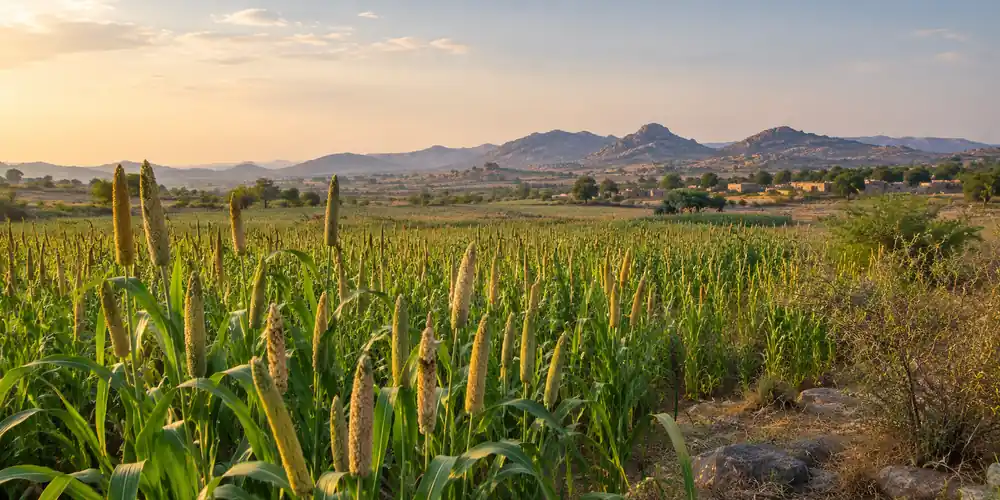
Jawai is often introduced through its granite hills, reservoir and leopard country, but the surrounding countryside has another rhythm: the agricultural year. Across Pali district, fields respond to monsoon rain, irrigation and changing temperatures. Understanding this calendar helps visitors notice why one visit may reveal newly sown fields, another standing millet, and a later journey mustard, wheat or fallow land.
The pattern is not identical in every village. Soil, irrigation, rainfall and farmers’ decisions all influence what is grown. This guide uses district-level crop references and current Rajasthan-wide context; it is not a promise that a particular crop will be visible on a particular date.
Why the agricultural calendar matters in Jawai
Pali lies in a dry to semi-arid part of Rajasthan where rainfall can be uneven. The Central Ground Water Board’s Pali district aquifer-management report describes agriculture as vulnerable to dry weather and unreliable rainfall. It notes that traditional Kharif cultivation depends heavily on the monsoon, while Rabi cultivation is more common where irrigation is available. The same field may look very different from one season to another, and nearby farms may follow different schedules.
Rajasthan’s Economic Review 2025–26 also explains that crop production in the state depends on the timely arrival and distribution of monsoon rain. At state level, it identifies bajra, groundnut and moong among important Kharif contributors, while wheat, rapeseed and mustard, and gram are major Rabi contributors. These are state-wide observations, not a crop-by-crop forecast for Jawai, but they help place Pali’s farming calendar in its wider regional setting.
Kharif: farming begins with the monsoon
Kharif is the main rain-linked cropping season in much of the dry western region. Sowing generally follows the onset of dependable monsoon moisture, rather than a fixed date that every farmer can follow. If rain arrives late, arrives in short bursts or has long gaps, sowing decisions may change. A good season depends not only on total rainfall but also on how evenly it is spread while crops establish and grow.
The Central Ground Water Board’s district crop summary lists jowar, bajra, moong, sesame (til), castor, henna (mehendi) and cotton among Kharif crops recorded for Pali. This list is based on district statistical material cited in the report, so it should be treated as a documented district reference rather than a current inventory of every Jawai village. Pearl millet, or bajra, is especially associated with dryland farming because it is suited to hot conditions and relatively low rainfall compared with many other cereals.
After the first effective rains, fields may show fresh preparation, sowing activity and new green growth. Later, where the crop has established successfully, the countryside can become noticeably greener. By the time crops mature, the visual character changes again: seed heads develop, plants dry and harvesting begins. The sequence varies with rainfall and crop choice, so fields will not all be at the same stage.
Rabi: winter crops depend more on available water
Rabi crops are generally sown after the monsoon season and develop through the cooler months. In Pali, the district-level crop list includes wheat, barley, gram, mustard, taramira and cumin. The Central Ground Water Board notes that Rabi cultivation in the district is more prevalent where irrigation facilities are available. This is an important difference from rain-dependent Kharif farming.
For a visitor, the winter countryside may include prepared plots, young crops, mustard flowers in some areas, or fields approaching harvest later in the season. None of these sights is guaranteed. Farmers choose crops according to their land, water access, seed, market conditions and the weather they have experienced. A field that appears bare may be resting, awaiting sowing, or being prepared for another crop; it should not automatically be described as abandoned.
The state-wide Economic Review 2025–26 identifies wheat, rapeseed and mustard, and gram as important contributors to Rajasthan’s Rabi crop sector. Pali’s local list includes these as well as barley, taramira and cumin. The overlap places Pali within the wider agricultural economy while retaining its own crop mix.
Zaid and the months between the main seasons
Some agricultural calendars also refer to a short Zaid season between the main Kharif and Rabi cycles. The Pali district crop summary records jowar, fruits and vegetables in this category. Such cultivation is more dependent on water availability and local conditions, so it should not be treated as widespread or assured throughout the Jawai area.
Agriculture does not stop neatly when one season ends. Land may be harvested, prepared, left fallow or used for fodder. Mixed farming and livestock are important to rural livelihoods in dry and semi-arid Rajasthan, so a quiet-looking field may still be part of a working farm system.
How rainfall shapes what you see
Rainfall variability is central to the Pali story. The Central Ground Water Board’s district assessment analysed rainfall records from 1971 to 2019 and reported substantial variation between years. The report’s historical averages should not be mistaken for a current forecast, but its findings underline why a fixed seasonal description can be misleading. A monsoon that performs well in one year may be weak or uneven in another.
Crop appearance is not a reliable calendar by itself. A green field does not prove the whole region has had abundant rain, and a dry field does not necessarily mean a crop has failed. Soil, irrigation, crop variety and rainfall timing all matter. Ask a local guide or host what is being grown before approaching a field.
Respectful ways to notice rural life
Agricultural land is working property, not an open visitor attraction. View fields from public roads or places where your host has permission for you to stop. Do not walk through crops for a photograph, pick seed heads, move equipment or block farm tracks. Ask before photographing farmers, workers, homes or livestock. A respectful distance protects both the crop and the privacy of the people who live and work there.
A guide’s explanation should be treated as local context, not a description of every farm. Sowing and harvest can vary between neighbouring plots. Do not ask people to interrupt work for a staged photograph; let your host arrange permission if you want a closer look.
The agricultural landscape also connects with Jawai’s wider cultural setting. The region’s villages, pastoral traditions and everyday livelihoods are part of the story that sits alongside wildlife and the reservoir. Explore Jawai’s About page introduces the wider setting of the region and its communities; this farming calendar adds another way to read that landscape.
When is the best time to see the changing fields?
There is no single best month for every crop. After the monsoon, fields may show fresh growth or maturing Kharif crops. Cooler months are associated with Rabi crops, while hotter months may bring harvested or resting plots and limited Zaid cultivation where water allows.
If a particular crop is important to your visit, ask locally shortly before travelling rather than relying on a fixed online calendar. A guide or accommodation host may be able to explain what is visible in the surrounding area at that time. Do not expect access to a farm unless permission has been arranged.
A different way to understand Jawai
Jawai’s appeal is not limited to a single wildlife sighting or a view of the reservoir. The region is a lived-in landscape where rainfall, fields, livestock, villages and rocky terrain shape everyday life. Recognising the Kharif and Rabi seasons makes a drive through Pali district more meaningful: the colours of a field have a reason, and the work behind them changes through the year.
Travel with curiosity and respect. Treat crop lists as regional guidance, ask what is happening that season, and observe from places where visitors are welcome. The agricultural calendar then becomes another window into Jawai without intruding on the people who make the countryside work.
Frequently asked questions
What are the main farming seasons around Jawai?
The main seasons are Kharif, which depends largely on monsoon rain, and Rabi, which is more common where irrigation is available. Some district references also record a shorter Zaid season.
Which Kharif crops are recorded in Pali district?
A Central Ground Water Board district report lists jowar, bajra, moong, sesame, castor, henna and cotton. The list is a district-level reference and should not be read as a live crop inventory for every village.
Which Rabi crops are grown in Pali?
The same district report lists wheat, barley, gram, mustard, taramira and cumin. Actual crop choice depends on water access, soil, weather and the farmer’s decision.
Can visitors enter fields to take photographs?
Only with the landholder’s permission. Fields are private working spaces. Photograph from public roads or approved viewpoints, and ask before taking pictures of people or livestock.
Does every year have the same crop calendar?
No. Rainfall timing and distribution, irrigation access and local decisions can shift sowing and harvest. Check with a local host or guide close to your travel date for a realistic picture of what is visible.