
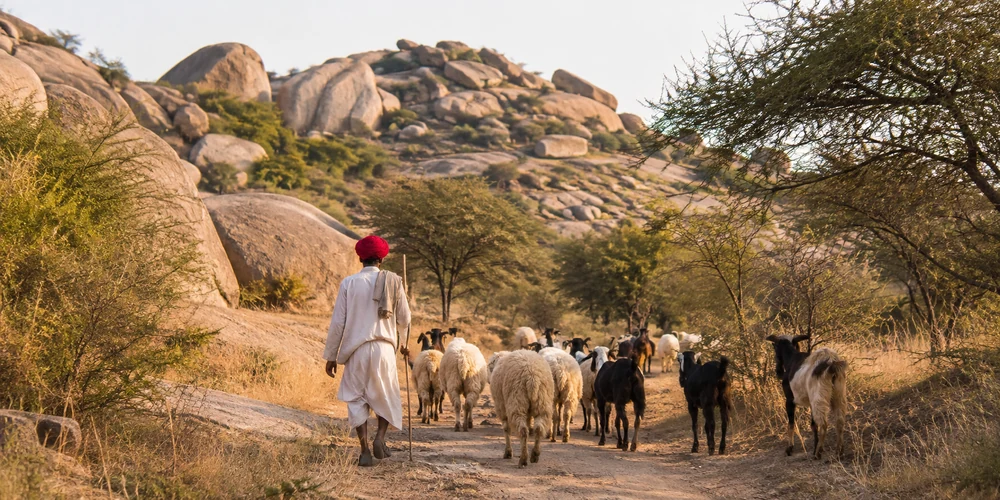
Jawai is often introduced through its granite hills and leopard safaris, but the region is also a lived-in rural landscape shaped by people, livestock, seasonal work and long-standing local knowledge. The Rabari community is an important part of this story. Traditionally associated with pastoral livelihoods, Rabari families in Rajasthan and neighbouring regions have maintained relationships with animals and changing landscapes across generations. Around Jawai, visitors may encounter herders and their flocks on village roads and open grazing land, often with the rocky hills in the background.
Understanding Rabari culture in Jawai means looking beyond a photograph or a short village stop. It means recognising that people have their own routines, work, beliefs and changing aspirations. A thoughtful visit should create space for conversation when it is welcomed, support local livelihoods fairly and respect the privacy of families.
Who are the Rabari?
The Rabari, also written as Rebari in some regional contexts, are a pastoral community found across parts of Rajasthan and Gujarat. Pastoralism traditionally involves keeping and caring for livestock, with daily decisions shaped by grazing, water, weather and the needs of animals. Historical and cultural documentation describes Rabari livelihoods that have included camels, sheep, goats, cattle and buffalo. The mix of animals and occupations differs between regions and families, so no single description represents every Rabari household.
The Indira Gandhi National Centre for the Arts documents the community’s regional diversity and its long association with pastoral life and embroidery. This is useful background, but visitors should remember that a broad account of Rabari communities across western India cannot be treated as a precise description of every family around Jawai.
How pastoral life connects with the Jawai landscape
The Jawai region is recognised for its distinctive granite outcrops, scrubland, village settlements and the reservoir landscape. These are not separate worlds. They form part of a working countryside where people travel between homes, fields, grazing areas and local services. Livestock movement is one of the visible elements of this landscape, particularly when herds are being taken out or brought back.
Jawai is also known for the presence of leopards in the wider hill country. The relationship between people, livestock and wildlife is complex and should not be reduced to a simple story that everyone lives in perfect harmony. Livestock loss can affect household livelihoods, and attitudes and experiences differ. Responsible travel should listen to local perspectives rather than assume that every family shares the same beliefs or experience.
Everyday scenes visitors may notice
Herds moving through the countryside
Sheep, goats and other livestock may be seen along rural tracks or grazing in open areas. These are working animals being managed by their owners, not part of a staged attraction. If a herd crosses the road, slow down, give it room and follow the herder’s directions. Do not sound the horn repeatedly or try to move animals for a photograph.
Traditional clothing and personal expression
Some visitors notice turbans, white clothing, embroidered textiles, jewellery or distinctive garments. Clothing practices vary by family, age, occasion and individual preference. The IGNCA’s cultural archive records examples of Rabari dress and embroidery, while contemporary reporting from Jawai describes how work, education and changing opportunities are influencing everyday life. Treat clothing as personal and cultural expression, not as a costume that someone is wearing for visitors.
Craft, embroidery and household traditions
Embroidery is an important part of the cultural record associated with Rabari communities. IGNCA collections include examples of embroidered clothing and household textiles. If a local artisan or family offers work for sale, ask about the maker, materials and price, and buy only if you genuinely wish to. Do not assume that every household produces crafts or that a demonstration is available on demand.
Can travellers visit a Rabari village in Jawai?
A village visit may be possible when it is arranged through a responsible local guide, host or accommodation with genuine community relationships. Availability, access and the nature of the visit can vary. There is no reason to assume that every village welcomes visitors or that homes and courtyards are public spaces.
Before confirming an experience, ask who will host the visit, whether the family has agreed to receive guests, what the visit includes and how payment is shared. Find out whether the experience is a guided walk, a conversation, a craft interaction or simply an opportunity to learn about the surrounding landscape. A clear explanation helps avoid misunderstandings and makes it easier to decide whether the activity is appropriate.
Prefer a visit that follows the household’s schedule. If a family is busy, unavailable or changes its mind, accept that without pressure. A respectful operator should be comfortable changing or cancelling a visit rather than treating access to residents as something guaranteed by a booking.
How to behave respectfully during a village visit
Good cultural travel begins with consent. Ask before taking photographs or recording video, and accept a refusal immediately. Be especially careful when photographing children, women, private homes or religious activity. A guide’s permission does not automatically replace the consent of the person being photographed.
Dress modestly and behave as you would when visiting someone’s home. Do not enter a house, animal enclosure, courtyard or private field unless you are invited. Avoid touching livestock, feeding animals or interrupting work. Keep your voice low, do not crowd people and allow residents to continue their day without feeling observed.
If you are invited to share tea or food, follow your host’s lead and mention dietary requirements politely. Do not make assumptions about what a family should serve or how a household should look. Avoid intrusive questions about income, marriage, religion or family matters. Ask open questions about topics the host chooses to discuss, such as livestock care, seasonal routines, crafts or changes in village life.
How responsible visitors can support local livelihoods
Responsible support is not limited to spending money. Follow local road guidance, avoid leaving litter, do not block access for residents and livestock, and respect working areas. Keep vehicles on permitted routes and do not ask a driver to approach animals or people for a closer photograph.
Most importantly, do not treat the community as a wildlife prop. The people of Jawai are residents with varied livelihoods and ambitions. Their value is not measured by how closely their lives match a visitor’s idea of tradition.
Combining cultural learning with a Jawai wildlife trip
When is a good time to learn about village life?
Experience Jawai with curiosity and respect
Rabari culture is not a performance arranged around a tourist timetable. It is part of a diverse and evolving community life that sits within Jawai’s wider rural landscape. Visitors can learn a great deal by observing from an appropriate distance, listening when conversation is welcomed and supporting locally led experiences that respect consent.
To understand the wider destination context, explore the About Explore Jawai page as well. Approach every encounter with patience: the most meaningful cultural experience is one in which residents retain control over what they share and visitors leave with a deeper respect for the place.
Frequently asked questions
Who are the Rabari people of Jawai?
The Rabari are a pastoral community found across parts of Rajasthan and Gujarat. In the Jawai region, pastoral livelihoods and village life form part of the wider rural landscape, although occupations and experiences differ between households.
Can tourists visit Rabari villages near Jawai?
Some visits may be arranged through local hosts, guides or accommodations, but access is not automatic. Confirm that the family has agreed to receive visitors and ask what the experience includes before booking.
What should I wear when visiting a village?
Choose comfortable, modest clothing suited to the weather. Follow your host’s guidance, particularly if the visit includes a religious or community space.
Is it okay to photograph Rabari people?
Only after asking the individual for permission. Be especially considerate when photographing children, women, homes or private activities, and respect anyone who does not wish to be photographed.
What is the best way to support the local community?
Choose locally led experiences with transparent arrangements, pay agreed fees fairly, buy crafts directly when available and respect residents’ time, privacy and working routines.
Are Rabari families’ lifestyles the same across Rajasthan?
No. Rabari communities are regionally diverse, and livelihoods, clothing, customs and daily routines vary. General cultural descriptions should not be assumed to represent every family in Jawai.